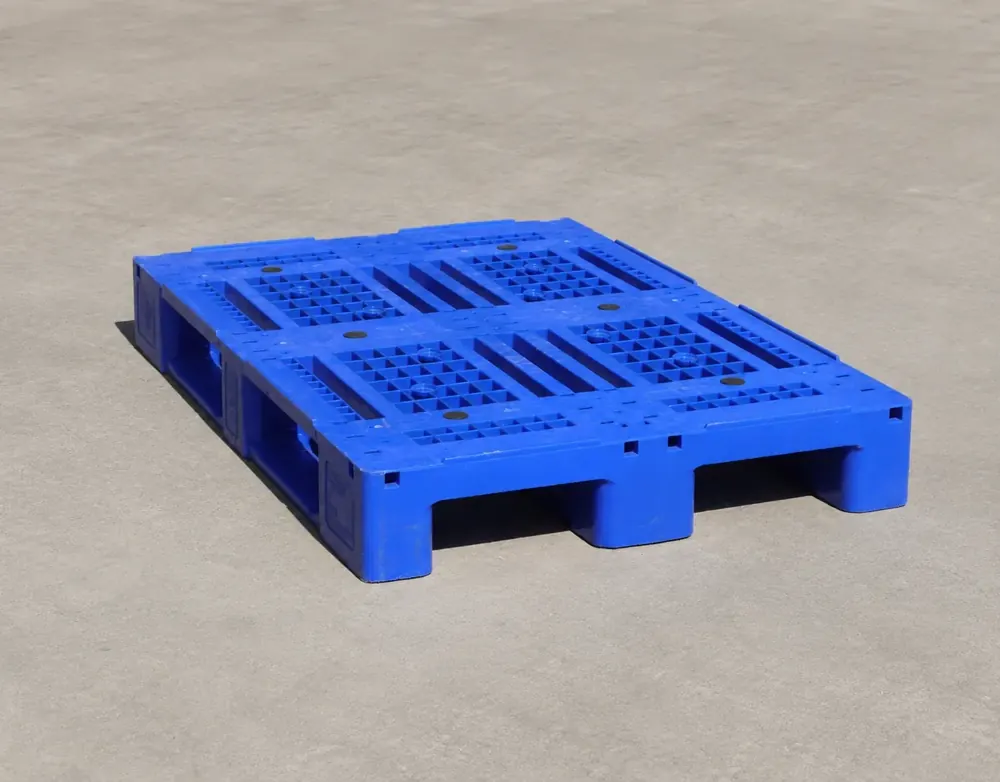
Plastic pallets
No solid wood
Plastic pallets contain no solid wood, so ISPM 15 does not regulate them, and nestable plastic pallets are one build.
- No solid wood
- Open grid and closed deck builds
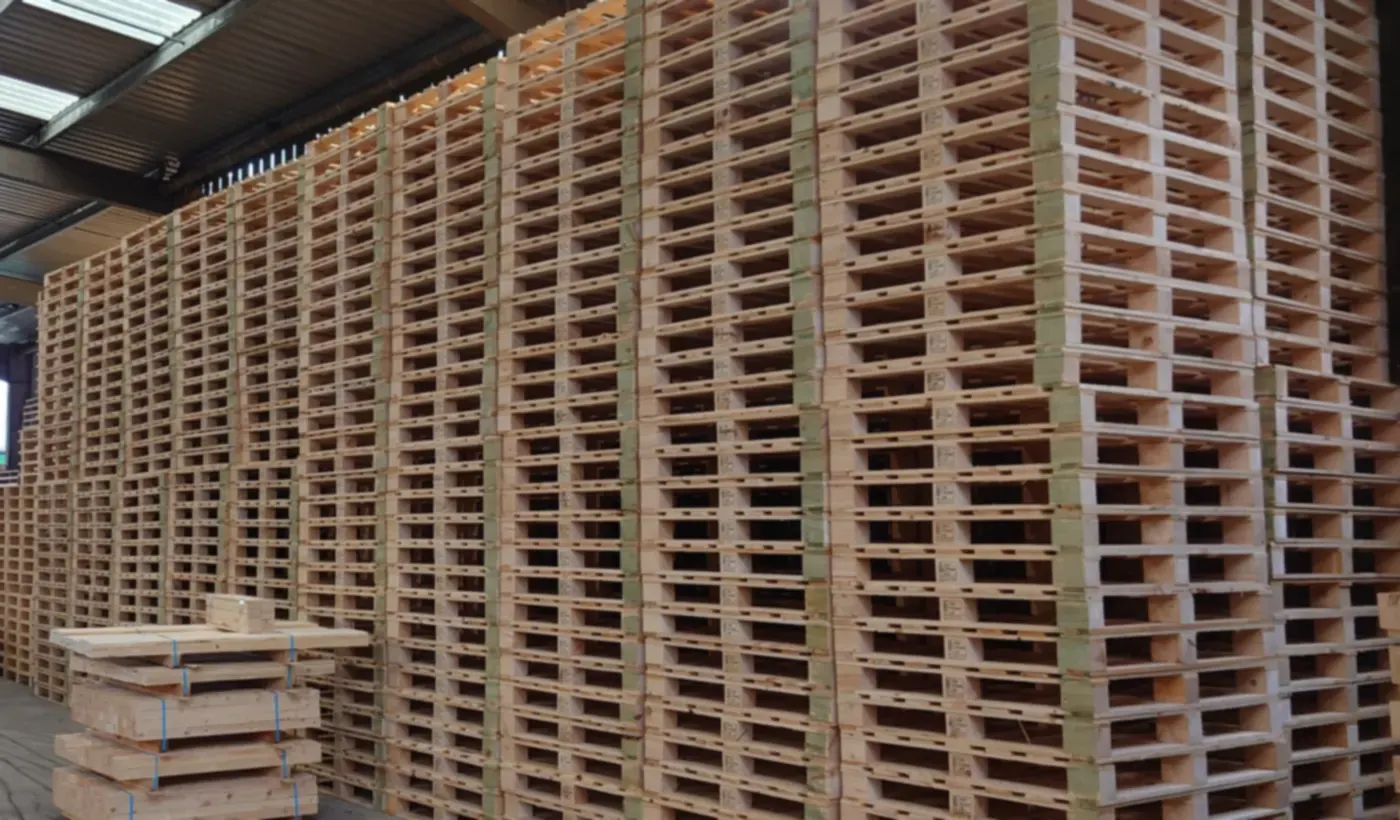
ISPM 15 is the international standard for treating and marking wood packaging. Solid wood pallets, crates and collars are debarked, heat treated to 56°C at the core for at least 30 continuous minutes or fumigated, then stamped.
In Great Britain the rules have applied since 1 January 2021 to wood packaging moving to or from other countries, including EU member states and Switzerland, and to wood packaging sent to Northern Ireland.
Rules checked against GOV.UK on 8 November 2026. The GOV.UK page was last updated on 22 April 2026.
ISPM 15 is the international standard for wood packaging material in international trade, and solid wood packaging is debarked, treated against pests and carries a mark that proves it, according to the standard and GOV.UK.
The standard, "Regulation of wood packaging material in international trade", was first adopted by the International Plant Protection Convention in March 2002 and last revised in 2018. When you pack a load for the EU, the mark on each pallet is what the rule asks you to show.
ISPM 15 covers packing cases, boxes, crates, drums and similar containers, pallets with their collars and other load boards, and dunnage, six kinds of wood packaging, according to GOV.UK.
| Wood packaging | Named in GOV.UK's list | Named in the standard, section 2 |
|---|---|---|
| Packing cases | "packing cases" | "packing cases" |
| Boxes | "boxes" | "boxes" |
| Crates | "crates" | "crates" |
| Drums and similar containers | "drums and similar containers" | "cable drums and spools/reels" |
| Pallets, box pallets, pallet collars and other load boards | "pallets, box pallets, pallet collars and other load boards" | "pallets" |
| Dunnage | "dunnage (loose wood used to protect goods and their packaging)" | "dunnage" |
ISPM 15 covers the packaging that carries the goods, in solid wood.
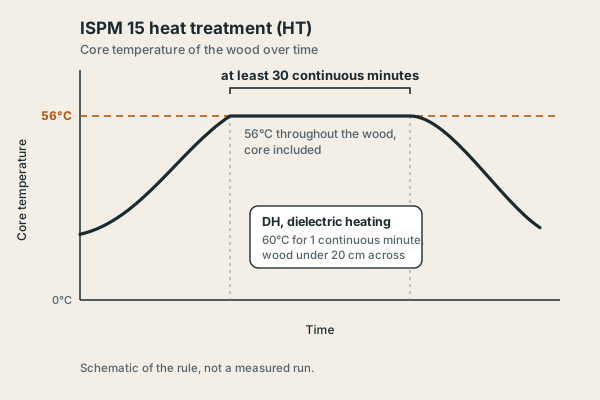
Wood packaging meets ISPM 15 once it is debarked and heat treated to 56°C for at least 30 continuous minutes throughout the wood, core included, or fumigated, according to GOV.UK.
| Treatment | Code on the mark | What the wood has to reach | Source |
|---|---|---|---|
| Heat treatment in a kiln or heat chamber | HT | 56°C for at least 30 continuous minutes throughout the wood, core included | GOV.UK; ISPM 15 Annex 1 |
| Dielectric heating (microwave or radio waves) | DH | 60°C for one continuous minute throughout the wood, surface included; wood under 20 cm across its smallest dimension | GOV.UK |
| Methyl bromide fumigation | MB | bark removed before treatment | GOV.UK |
| Sulphuryl fluoride fumigation | SF | bark removed before treatment | GOV.UK |
Every method starts with debarked wood, and small pieces of bark stay allowed if each is under 3 cm wide, or wider but under 50 cm² in total. Kiln drying alone is not on the list of four. Pallets treated this way are sold as heat treated pallets.
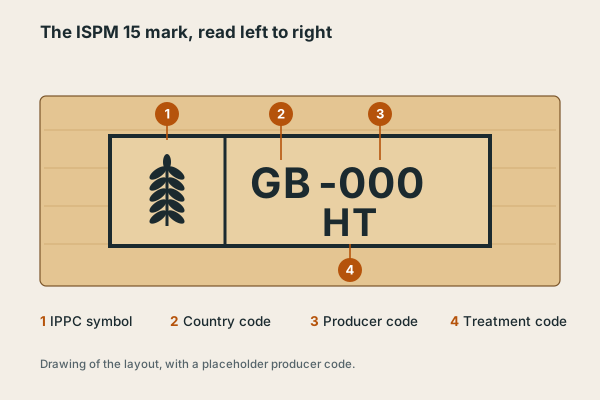
The ISPM 15 mark shows the IPPC symbol, a two-letter country code, a producer code and a treatment code (HT, DH, MB or SF), in a bordered rectangle with the symbol on the left.
ISPM 15 applies to wood packaging moving from Great Britain to the EU and Switzerland, from Great Britain to Northern Ireland and into Great Britain from any country, and wherever else the destination asks for it, according to GOV.UK.
| Journey | ISPM 15 mark needed | What to check | Source |
|---|---|---|---|
| Great Britain to the EU and Switzerland | Yes, since 1 January 2021 | the mark on every pallet, collar and crate | GOV.UK; Defra |
| Great Britain to Northern Ireland | Yes; checks are risk-targeted | the mark on every pallet, collar and crate | GOV.UK |
| Great Britain to other countries | Depends on the destination | the destination's own rules, before packing | GOV.UK |
| Into Great Britain from any country | Yes, for solid wood packaging | the mark on arrival; the wood may be checked at the border or at inland premises | GOV.UK |
| Northern Ireland to Great Britain or the EU | No change to the rules | the packaging as before 1 January 2021 | GOV.UK |
| Within Great Britain | Outside these rules | nothing under ISPM 15 | GOV.UK |
Imports that fail the check "could be rejected or destroyed", and the goods then need another way to travel, according to GOV.UK. For exports, the destination country applies its own checks.
ISPM 15 exempts processed wood such as plywood, thin wood of 6 mm or less, wine and spirit barrels, gift boxes of processed wood, sawdust, shavings and cardboard packing, according to GOV.UK.
| Exempt item | Why it falls outside | Source |
|---|---|---|
| Processed, non solid wood packaging such as plywood | the wood is processed so that it is free of pests | GOV.UK; ISPM 15 Scope |
| Raw wood 6 mm thick or less | the standard rates thin wood as low risk | GOV.UK; ISPM 15 section 2.1 |
| Barrels for wine and spirits | the barrels are heated during manufacture | ISPM 15 section 2.1 |
| Gift boxes made from processed wood | the wood is processed so that it is free of pests | GOV.UK |
| Sawdust | listed as exempt by name, with no packaging form | GOV.UK |
| Shavings | listed as exempt by name, with no packaging form | GOV.UK |
| Cardboard used as packing material | the packing is paper, not solid wood | GOV.UK |
Plywood, particle board, oriented strand board and veneer count as processed wood in the standard, and makers class presswood pallets the same way, so a destination's own rule is checked for them.
No solid wood
Plastic pallets contain no solid wood, so ISPM 15 does not regulate them, and nestable plastic pallets are one build.
No solid wood
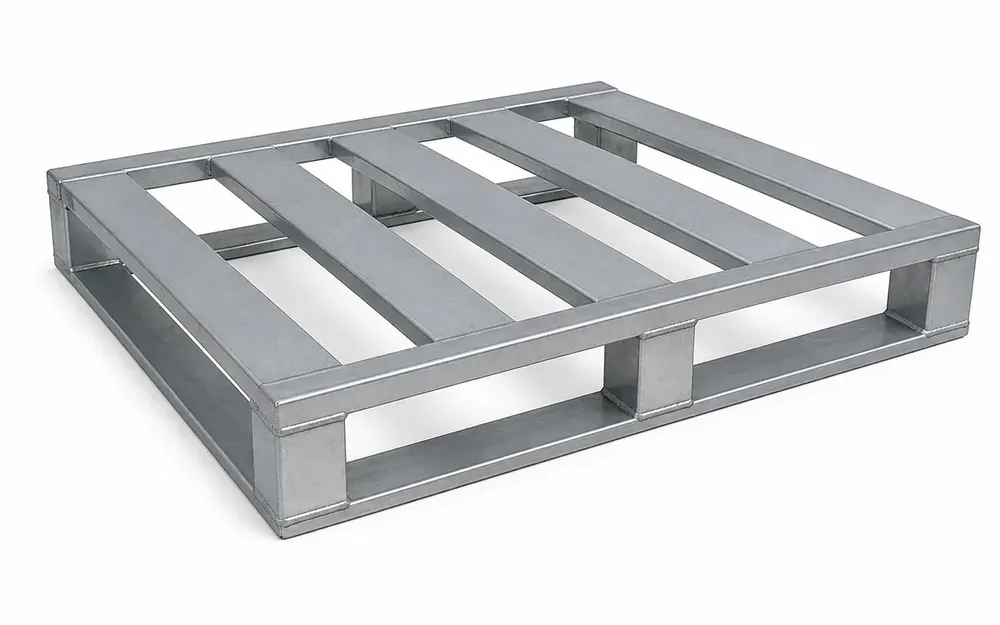
Metal pallets contain no solid wood, so ISPM 15 does not regulate them; steel and aluminium builds are the usual ones.
No solid wood
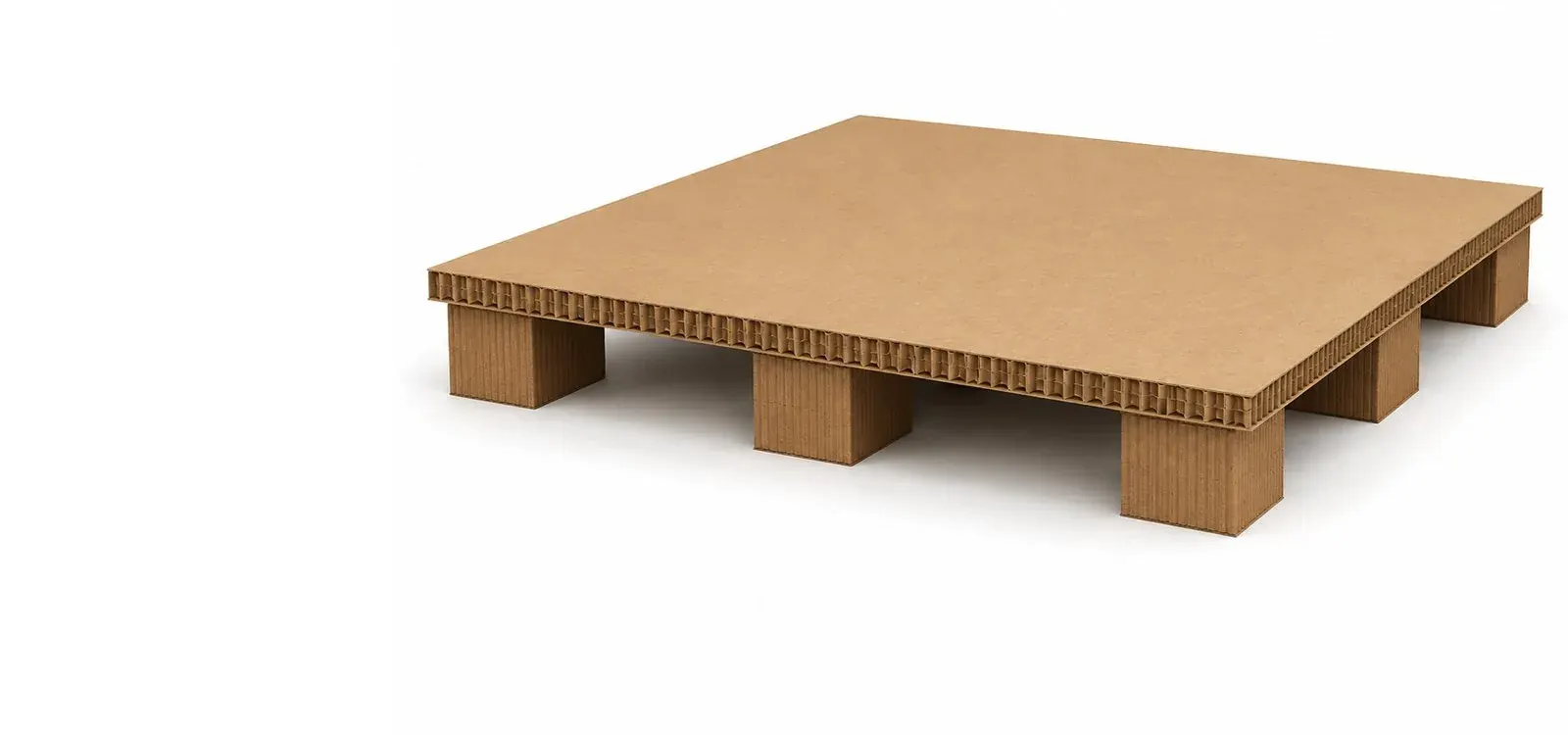
Cardboard pallets contain no solid wood, so ISPM 15 does not regulate them; GOV.UK exempts cardboard used as packing material.
Outside the exempt list, only treatment and a mark make wood packaging compliant, and only registered businesses may apply them.
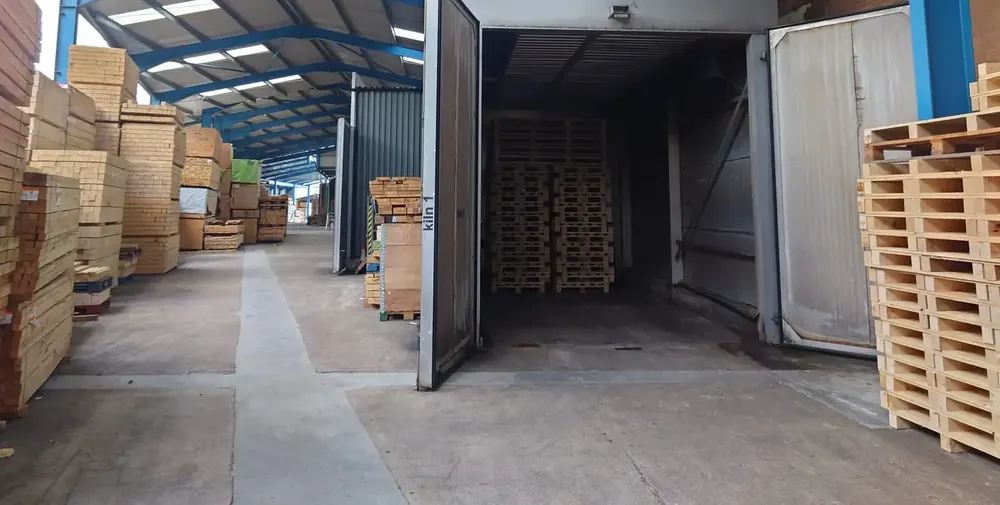
Only members of the UK Wood Packaging Material Marking Programme who are registered with the Forestry Commission as professional operators produce ISPM 15 compliant packaging in Great Britain, with their facility assessed every 6 months, according to GOV.UK.
The marking programme's public register listed 582 members on 2 November 2026, 130 of them with a kiln on site.
Every heat treated pallet we supply is heat treated and carries the ISPM 15 mark, and only registered members of the UK Wood Packaging Material Marking Programme may apply it.
GOV.UK points to the Timber Packaging and Pallet Confederation for further advice on moving wood packaging.
An ISPM 15 pallet needs no phytosanitary or treatment certificate when it carries a legible mark, because the mark itself carries the certification, according to GOV.UK.
| Document | Needed with a legible mark? | Source |
|---|---|---|
| Phytosanitary certificate for the packaging | No | GOV.UK |
| Treatment certificate | No | GOV.UK |
| Export phytosanitary certificate for an empty pallet | No, the mark replaces it | Defra |
Certification cannot be used instead of the mark, according to GOV.UK, so the mark is the document. A supplier can still send treatment details for a batch, and ours are sent with the delivery on request.
ISPM 15 treatment has no expiry date, and a treated and marked pallet stays compliant for its service life while its mark stays legible and it is not repaired or remanufactured, according to the standard and Defra.
| Situation | What ISPM 15 says | Source |
|---|---|---|
| Reused as it is | No re-treatment and no new mark for its service life | the standard, section 4.3.1; Defra |
| Mark no longer legible | The mark is the proof, and a legible mark is what meets the standard | GOV.UK; Defra |
| Repaired (up to about one third of components replaced) | Only ISPM 15 treated wood is used, and each added component is marked | the standard, section 4.3.2 |
| Remanufactured (more than about one third replaced) | Earlier marks are obliterated, the unit is re-treated and the mark is applied anew | the standard, section 4.3.3 |
A pallet arriving in the UK with a legible mark is reused for export to the EU and other countries without further treatment, according to Defra, and a treated, marked pallet that has been repaired or remanufactured needs re-treatment and re-marking before export.
We sell heat treated pallets and collars carrying the ISPM 15 mark, in UK standard 1200 x 1000 mm, Euro 1200 x 800 mm, CP and square sizes, delivered across the UK and priced to your postcode.
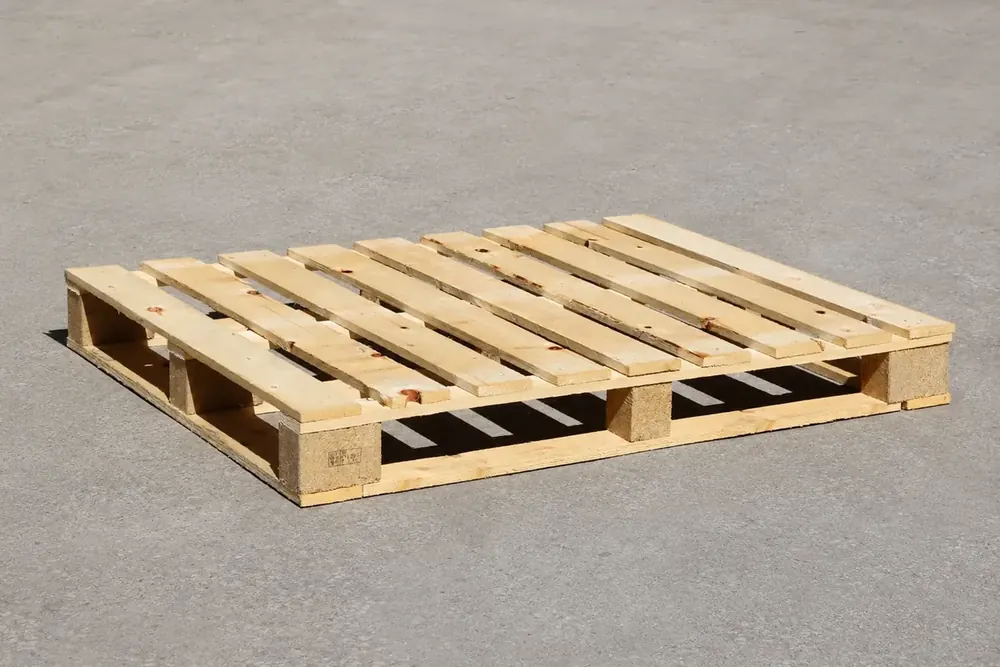
1200 x 1000, 1200 x 800 mm, CP, square
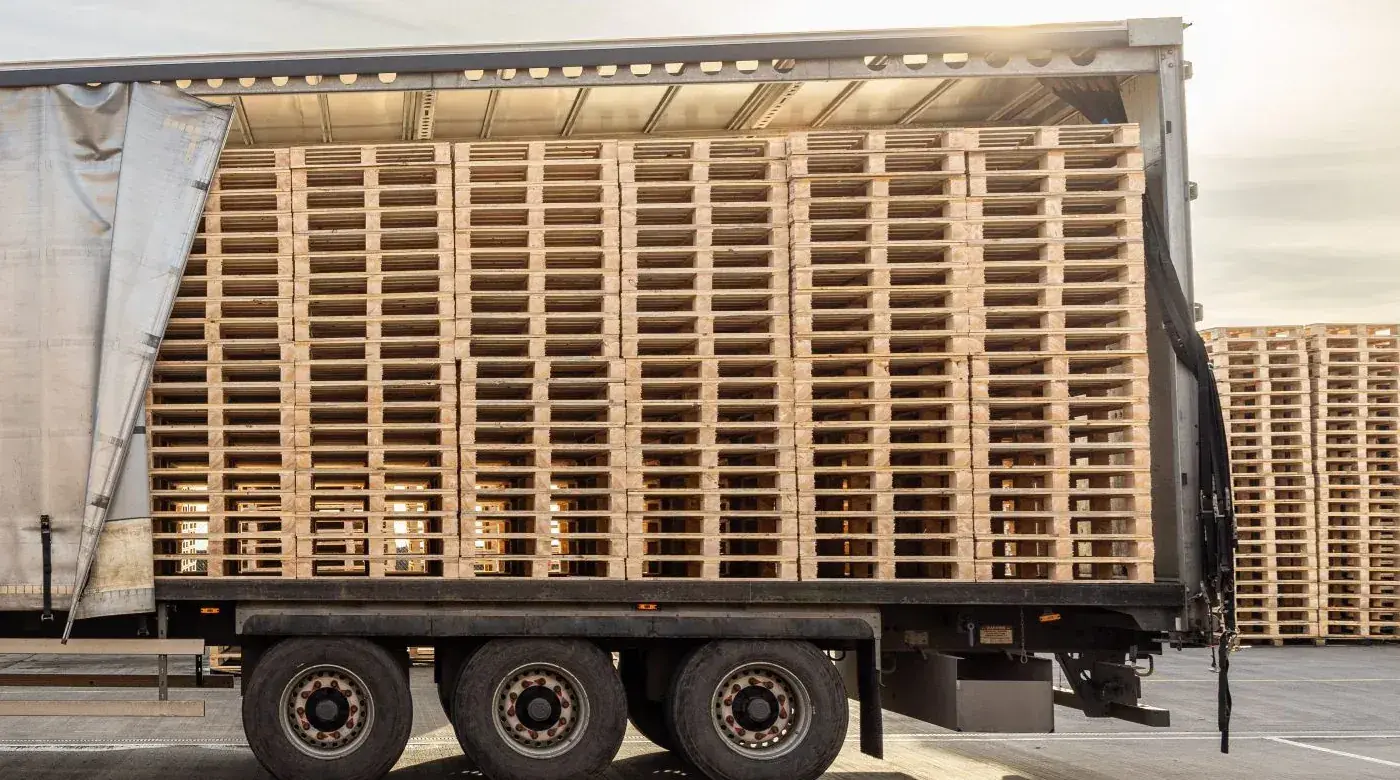
Heat treated pallets carry the ISPM 15 mark, new or used, for loads going to the EU, Northern Ireland or further afield.
1200 x 1000, 1200 x 800, 800 x 600 mm
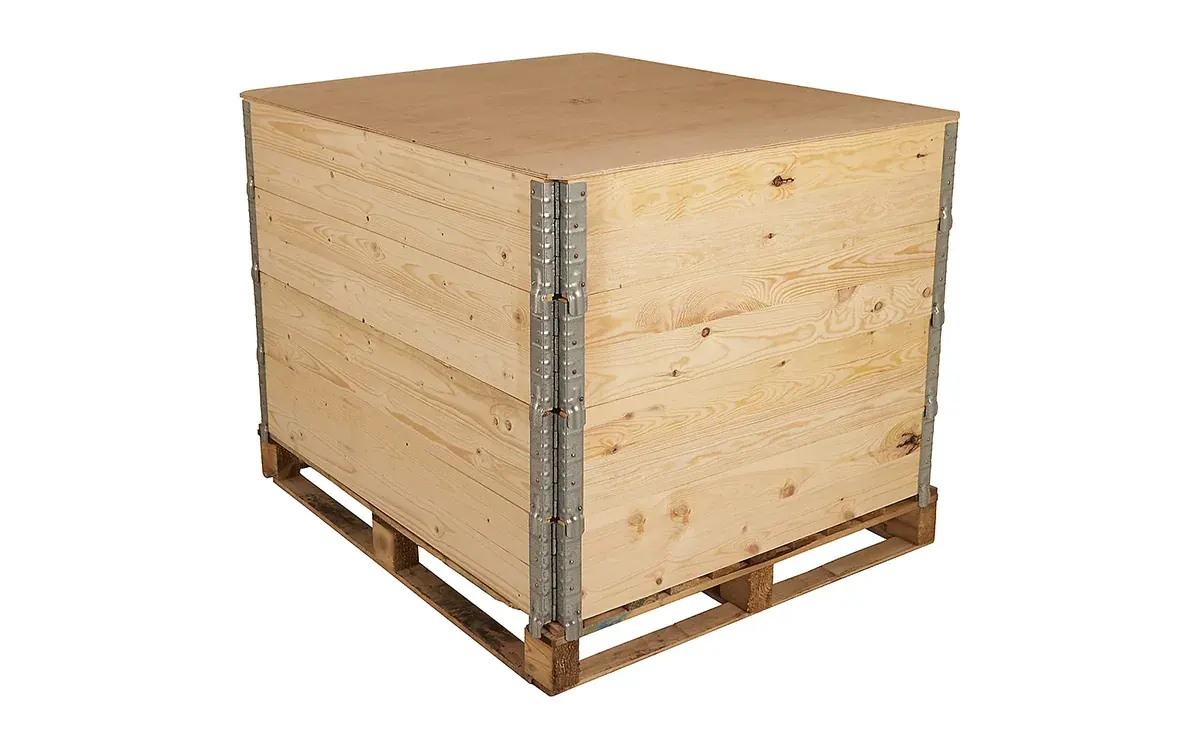
Heat treated pallet collars are wood packaging under ISPM 15, so they carry the mark with the pallet beneath them.
Send the destination, size and postcode when you request a quote, and we match the pallet.
Euro, CP and pool pallets meet ISPM 15 only through a legible mark on the pallet itself. EPAL states that its Euro and CP pallets are heat treated, and pool pallets stay their owner's property.
| Pallet | How ISPM 15 applies | Source |
|---|---|---|
| EPAL Euro pallet | EPAL marks include the IPPC mark, the country code and the treatment method; the ISPM 15 marks sit on both central blocks of the long sides | EPAL technical datasheet |
| CP pallets, CP1 to CP9 | EPAL's CP datasheets state ISPM 15 heat treatment, with the IPPC mark on the left-hand corner block | EPAL CP datasheets |
| Pool pallets (CHEP, LPR, IPP) | Compliant only through their own legible mark; they remain the pool's property, so we neither buy nor sell them | council guidance on CHEP pallets; site rule |
We deliver ISPM 15 pallets to any UK site a lorry can reach, with no minimum order. Send the size, number and postcode and we reply with a price.
No. Heat treatment is one of four approved ISPM 15 treatments, alongside dielectric heating and two fumigations, and HT is its code on the mark.
Yes. The IPPC symbol heads every ISPM 15 mark, so an IPPC stamp and an ISPM 15 stamp are the same mark, followed by a country code, a producer code and a treatment code.
Yes. ISPM 15 approves two fumigants, methyl bromide (MB) and sulphuryl fluoride (SF), applied after debarking, according to GOV.UK. The pallets we supply are heat treated.
No. Only a registered member of the UK Wood Packaging Material Marking Programme applies the mark, and the standard bans hand-drawn marks.
Yes. Solid wood pallet collars are wood packaging under ISPM 15, according to GOV.UK; plywood lids are processed wood and fall outside the rules.
Sources are GOV.UK, "Wood packaging material for import and export" (Forestry Commission, last updated 22 April 2026); ISPM 15, "Regulation of wood packaging material in international trade" (International Plant Protection Convention, adopted 2018, published 2019); Defra, "Wood Packaging Material (WPM) requirements from 1 January 2021" Q&A; EPAL technical datasheets. Checked on 8 November 2026.
Send the destination, size and postcode, then request a quote.