How to read pallet markings
Pallet markings are the stamps, brands and painted names on a pallet's blocks, and the ISPM 15 stamp, the EPAL oval, a CP number and a pool owner's name each say something different about the wood, the maker or the owner.
The stamp that matters most for export is the ISPM 15 mark, which has applied since 1 January 2021 to wood packaging moving from Great Britain to the EU, Switzerland and Northern Ireland.
Rules checked against GOV.UK on 12 November 2026. The GOV.UK page was last updated on 22 April 2026.
- The ISPM 15 stamp has four parts
- HT, DH, MB and SF are the four treatment codes
- Required since 1 January 2021 from Great Britain to the EU
Which marks are on your pallet?
The marks you can see on the blocks decide what the pallet is, and the destination decides whether those marks are enough.
Your result
Tick the marks on the pallet, choose the destination and press Decode the marks. The result explains each mark and whether the pallet is ready for that move.
What do the markings on a pallet mean?
The markings on a pallet show whether the wood is treated for export, who made or licensed the pallet and who owns it, and each family of mark sits in a different place on the blocks.
- ISPM 15 stamp
- The IPPC symbol, a country code, a producer code and a treatment code, proving the wood was treated for international trade.
- EPAL marks
- The EPAL oval, the IPPC mark, a control staple and a licence number on a Euro pallet built to EPAL rules.
- CP marks
- A number from CP1 to CP9 on the centre block, with an EPAL ID number.
- Pool marks
- An owner's name such as CHEP or IPP, which tells you the pallet is not for sale.
- No marks
- No proof of treatment, which rules out the export journeys that need the ISPM 15 mark.
What does the ISPM 15 stamp on a pallet show?
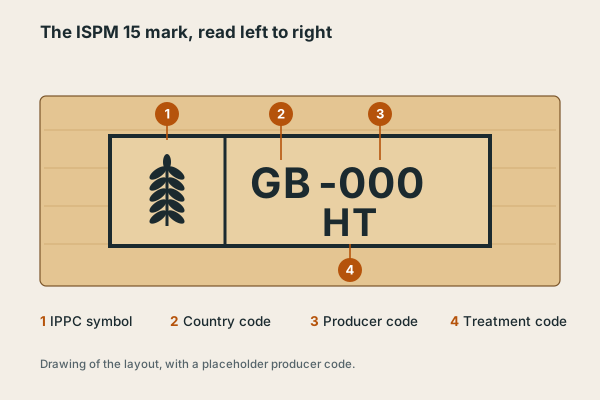
The ISPM 15 stamp on a pallet shows the IPPC symbol, a two-letter country code, a producer code and a treatment code, in a bordered rectangle with the symbol on the left.
- IPPC symbol
- The International Plant Protection Convention's symbol, placed to the left of the other parts.
- Country code
- The two-letter ISO country code, GB for Great Britain.
- Producer code
- The number the national authority assigns to the producer or treatment provider.
- Treatment code
- HT, DH, MB or SF, which names how the wood was treated.
- The mark has to be legible, durable and not transferable, and it is placed where it can be seen, preferably on at least two opposite sides.
- The mark is never hand drawn, and red or orange is avoided because those colours mark dangerous goods.
What do HT, DH, MB and SF mean on a pallet?
HT, DH, MB and SF are the four ISPM 15 treatment codes, standing for heat treatment, dielectric heating, methyl bromide and sulphuryl fluoride, according to Defra.
| Code | Meaning | What it tells you | Source |
|---|---|---|---|
| HT | Heat treatment | The core of the wood reached 56°C and held it for at least 30 continuous minutes | GOV.UK; Defra |
| DH | Heat treatment using dielectric heating | Wood under 20 cm across its smallest dimension reached 60°C for one continuous minute | GOV.UK; Defra |
| MB | Methyl bromide treatment | The wood was debarked, then fumigated | GOV.UK; Defra |
| SF | Sulphuryl fluoride treatment | The wood was debarked, then fumigated | GOV.UK; Defra |
| KD | Kiln dried | Not a treatment code, because kiln drying sets no minimum temperature | Defra; Forestry Commission |
| DB | Debarked | An older code from the Forestry Commission's 2003 note, not part of the current mark | Forestry Commission |
A kiln-dried pallet counts as treated only if the core of the wood also reached 56°C for 30 minutes, and that result is what the HT code records.
Is an MB pallet allowed?
Yes, under ISPM 15. An MB pallet is treated with methyl bromide, a code that stays valid under the standard, while EU member states have banned methyl bromide treatment since 19 March 2010, according to Wikipedia.
Defra lists MB as one of the four ISPM 15 treatment codes. EPAL states that methyl bromide treatment is prohibited for EPAL pallets, and the heat treated pallets we supply carry HT.
What marks does an EPAL Euro pallet carry?
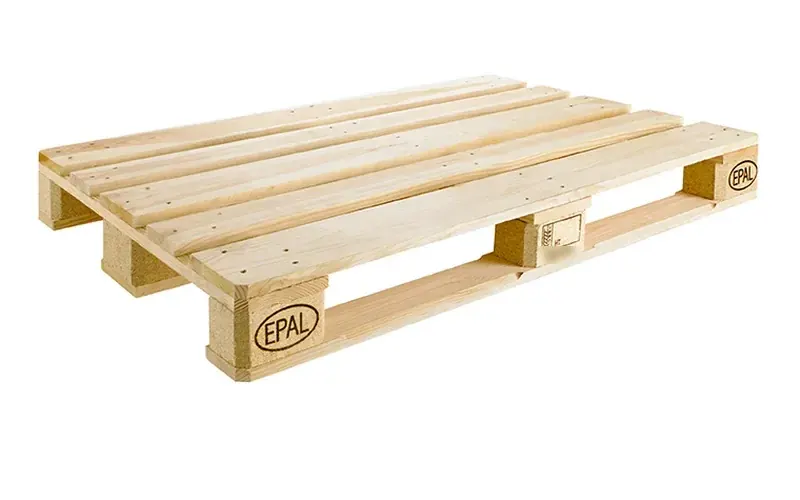
An EPAL Euro pallet carries the EPAL oval, the IPPC mark, a country code, a registration number, the treatment method, a control staple and an EPAL licence number with the year and month, according to EPAL.
| Mark | What it is | Source |
|---|---|---|
| EPAL oval | The branded marks of the European Pallet Association e.V. | EPAL |
| IPPC mark | Mandatory on EPAL pallets since 1 January 2010 | EPAL |
| Country code and registration number | The country and the number of the plant protection authority | EPAL |
| Treatment method | Heat treatment, shown as HT | EPAL |
| Control staple | A mandatory EPAL staple | EPAL |
| Repair marking nail | Present on repaired pallets only | EPAL |
| Licence number, year and month | The EPAL licence number with the year and month of making | EPAL |
On ISPM 15 treated pallets the marks sit on both central blocks of the long sides, and only licensed repairers may repair an EPAL Euro pallet.

How are CP pallets marked?
A CP pallet is marked with CP and its number, from CP1 to CP9, on the centre block together with the EPAL ID number, according to the EPAL CP datasheets.
- Right-hand corner block
- The EPAL oval.
- Left-hand corner block
- The IPPC symbol, the country code, the plant protection authority's registration number and HT.
- Centre block
- The CP number with the EPAL ID number, which is the licence number, year and month, beside the EPAL control staples.
A CP type name alone does not prove EPAL manufacture, heat treatment or export readiness, according to one UK supplier, so the stamp on the block is what to check.
Which pallets need the ISPM 15 mark?
Solid wood pallets need the ISPM 15 mark when they move from Great Britain to the EU and Switzerland or to Northern Ireland, and for other destinations where the country asks for it, according to GOV.UK.
| Journey or material | ISPM 15 mark needed | Source |
|---|---|---|
| Great Britain to the EU and Switzerland | Yes, since 1 January 2021 | GOV.UK; Defra |
| Great Britain to Northern Ireland | Yes, with risk-targeted checks | GOV.UK |
| Great Britain to other countries | Depends on the destination | GOV.UK |
| Within Great Britain | Outside these rules | GOV.UK |
| Plastic pallets | No, they are exempt | Wikipedia |
| Presswood, plywood and cardboard | No, processed and non-solid packaging is exempt | GOV.UK |
| Raw wood 6 mm thick or less | No, it is exempt | GOV.UK |
Makers class presswood as processed wood, so check the destination's own rule before relying on it.
What does a pallet with no stamp mean?
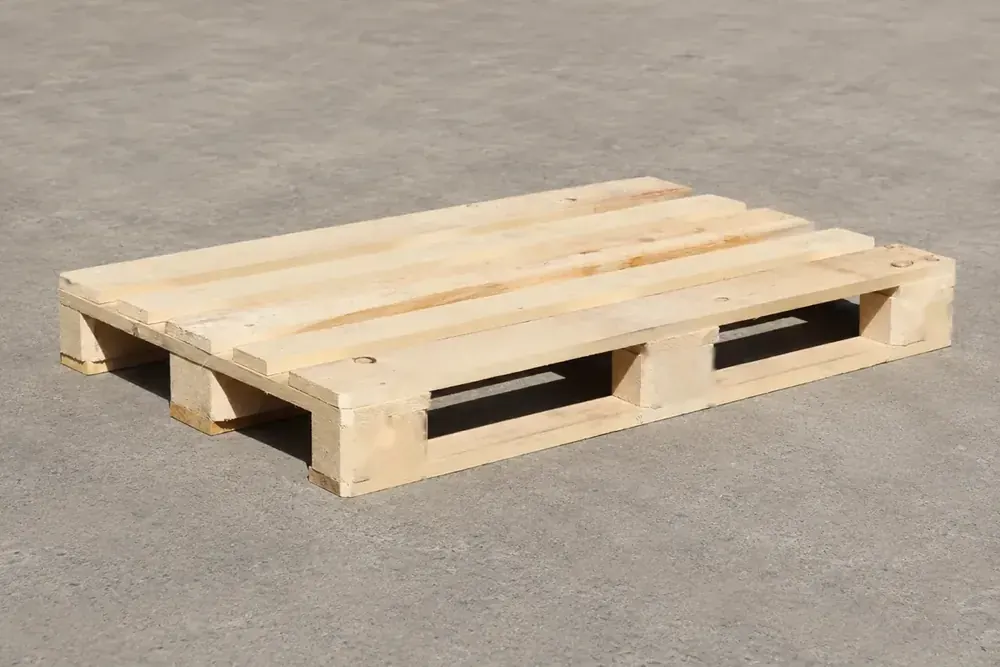
A pallet with no stamp has no proof of treatment, so solid wood in that state cannot go on the journeys that need the ISPM 15 mark.
A certificate cannot stand in for the mark, and wood packaging that fails the check could be rejected or destroyed, according to GOV.UK. A pallet without marks can still be a plain Euro-size build, because the size alone does not make it an EPAL pallet. Within Great Britain it sits outside the ISPM 15 rules.
How do you spot a CHEP, LPR or IPP pallet?
A CHEP, LPR or IPP pallet is a pool pallet carrying its owner's name, and it stays the owner's property, so we never buy or sell one.
- CHEP
- A blue pallet marked CHEP that stays CHEP's property and goes back to CHEP, according to council guidance.
- IPP
- A brick brown pallet marked "Property of IPP", "Property of IPP Logipal" or "Property PP", according to IPP.
- LPR
- A pallet carrying the LPR mark, from La Palette Rouge, a division of Euro Pool Group with UK service centres.
Pallet marking FAQs
What does HT mean on a pallet?
HT means heat treatment. The wood was heated to 56°C at the core for at least 30 continuous minutes, and HT is the treatment code at the end of an ISPM 15 mark.
Are pallets without a stamp safe to export?
No. Solid wood packaging moving from Great Britain to the EU, Switzerland or Northern Ireland needs a legible ISPM 15 mark, and a certificate cannot replace it, according to GOV.UK.
Can I stamp my own pallets?
No. Only a registered member of the UK Wood Packaging Material Marking Programme may apply the ISPM 15 mark, and the standard bans hand-drawn marks.
Is a KD stamp enough for export?
No. KD means kiln dried, and it is not one of the four ISPM 15 treatment codes, so a KD stamp alone does not meet the standard.
Does an ISPM 15 stamp expire?
No. A marked pallet stays compliant as long as the mark stays legible, and a repaired pallet needs re-marking by a member of the UK Wood Packaging Material Marking Programme, according to Defra.
Where can you buy pallets with the ISPM 15 mark?
We sell heat treated pallets that carry the ISPM 15 mark, delivered across the UK and priced to your postcode.
Our heat treated pallets are the ones to order for the EU and Northern Ireland, and ISPM 15 explained sets out the treatments and exemptions. For Euro-size stock see EPAL Euro pallets, for the CP range see CP pallets, and for pool pallets see CHEP pallets.
Sources are GOV.UK, "Wood packaging material for import and export" (Forestry Commission, last updated 22 April 2026); ISPM 15 and the Defra "Wood Packaging Material (WPM) requirements from 1 January 2021" Q&A; EPAL Euro pallet page and CP datasheets; Forestry Commission Information Note 1 (2003); council guidance on CHEP pallets; IPP FAQ. Checked on 12 November 2026.